
I have a Frankenfax, and I love it
A few years ago, I was in Paris travelling and popped into a FNAC to grab something I couldn’t find on-island where I live. Whilst there, I had a look at books and stationary, as one does and I picked up a Moleskine Weekly Notebook with a week on one page and opposite a lined notes page. I’d been using digital tools to organise my work and personal life for years, if not a couple of decades, and I’d found that they hadn’t helped me enough to organise my chaotic brain and working life —I’d started a new company and lived through the shitshow that was COVID-19. So a physical diary was an attempt at an antidote.
I’d owned a real Filofax in the late 80s and early 90s, and I remember it being useful and practical, but no more than that. As the Moleskine was to hand and reasonably priced, I took a shot at using it daily for planning, replicating the data into my digital systems. This dual-entry was actually helpful to anchor the things I needed to track, plan and execute. And so I’ve stuck to it ever since. For the following years, rather than getting a replacement, I opted for LEUCHTTURM1917 diaries. Again, week on the left plus lined notes on the right. This disposition seems to work for me as I can plan appointments on the left, write tasks on the right, but also add notes and other thoughts quickly on the open pages, so they are visible for me during the day. This visibility is important and the Achilles’ heel of digital systems on phones and tablets. No longer in sight, no longer existing. Additionally, at the back of the LEUCHTTURM1917 there are a few notes pages for longer notes and other stuff I might want to jot down. Having two ribbon page markers allows visual clues to there being ‘other stuff here’ was also an upgrade over the Moleskine.
And then I started to get interested in ring binders, à la Filofax. I liked the flexibility that I could add only the things I need, as an advantage. Additionally, I’d started to see numerous projects to self-print inserts, allowing me to create my own personal setup, without being beholden to the printing schedules of the manufacturers. I stumbled on a site called Philofaxy and thought I’d try out the free-to-use inserts available there. But firstly, I required a ring binder. I hopped on Leboncoin (a French sell-your-old-crap site) and found a sale locally, on the island, for a genuine Filofax A5 Metropol in faux leather. For €10, it was a no-brainer. So after a little organisation, I had it in my hands, and it was in near perfect condition. The seller kindly gave me a few other items like paper and dividers too so that was a bonus.
So my experiment began. I printed out the inserts I wanted after modifying the Word template to my tastes, and added the (kindly) supplied-in-the-sale note paper and started using it alongside the LEUCHTTURM1917 (together with the digital tools). Slowly, I noticed that I gravitated more towards the Frakenfax, seemingly confirming the experiment, eventually ditching the LEUCHTTURM1917.
I had a brief essaie with tabbed dividers, both commercial and self-printed downloads on 120 gsm paper, but I just couldn’t get used to them. I don’t need to separate the binder into topics, only types (diary, notes, annual planner). So I decided to make my own page markers, again, out of 120 gsm paper. I cut them to about an inch wide and ensured they were taller than A5 and wrote “Today”, “Notes”, “Planning” at the top and was happy with that setup. For a few weeks. Unfortunately, unprotected paper does take to being pulled left and right much, and I didn’t have any hole strengthener stickers (remember them?), so they started to look a little too rag-tag, even for my tastes. So I ordered three official Filofax A5 black ruler / page marker (343609) to fulfil the same role.
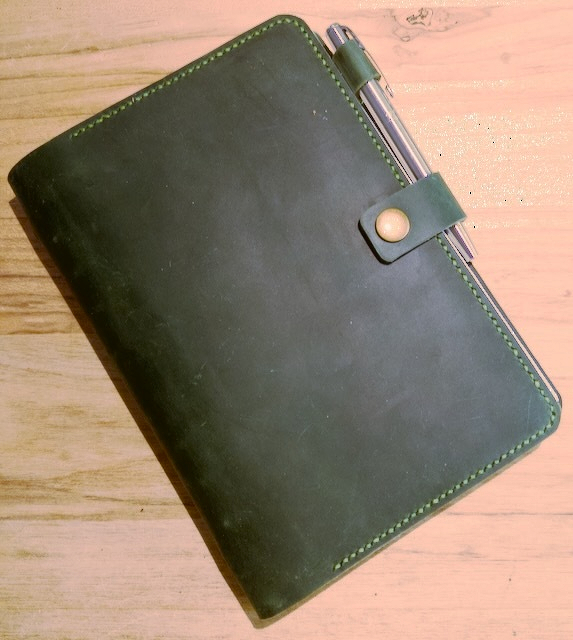
At the same time, I felt that the physical size of the Metropol was a little like putting an XXL jumper on a body of a petite corps. Additionally, the pockets and business card holder slots were superfluous to my requirements and so wasted. Looking on Etsy, at a shop I’d already used to order some leather notebook holders (DM Leather Studio), I wanted to get a leather binder rather than the cheap-feeling faux leather. I ended up ordering a green leather A5 binder and received it a couple of weeks later.
Transferring all the inserts, the page markers, and adding a Parker Jotter fountain pen in stainless steel into the pen loop felt like I reached the goal that I was hoping for. Even though the binder is A5, it is more proportionately sized for A5 inserts and looks better than the Filofax. It feels so much nicer to use daily. If I have one complaint, it is that the binder’s rings are a little tight at 15 mm, but its enough for what I need and helps ensure I don’t stuff the thing with too much crap. Given the ring mechanism is easily replaceable, I might look into replacing them with some slightly wider ones in the future. But that’s another project and not urgent.
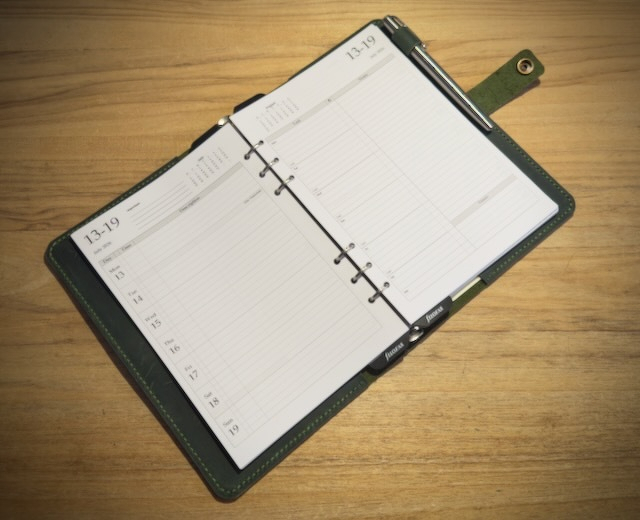
So there it is. My Frankenfax cobbled together from a handmade leather binder, modified self-printed diary inserts, official Filofax note paper and Filofax page markers.
It’s almost perfect!
Counting the days until the first Apple Watch Siri AI-induced feminicide.
I guess it’s move fast and (break things) kill people, now.
It doesn’t feel like this technology has been fully thought through, and coupling this with another firm’s “innovation” to stifle the audible alerts from AitTags, in what can only be described as a wet dream for stalkers, it shows that something is clearly very wrong in technosolutionist land.
Reading is a pleasure I developed several decades ago, when at a fairly young age, I was commuting to and from work for around four hours per day, and needed something to occupy myself besides the music from my portable tape player.
I’d had a bad experience at school with English, and hadn’t really enjoyed the subjects and the methods of teaching, let alone the teachers themselves. It left me feeling that I was a little stupid and unable to read or write well for my age. I’d started reading long before school, but school did its best to knock that pleasure out of me. So I was glad to get back into reading during the train and two bus rides, morning and evening.
The Internet came along and bizarrely accomplished the same thing that the school teachers seemed to be paid to do. I started off buying books through the Internet, to eventually only reading on the Internet, forgoing a wealth of good works and learning opportunities in the process.
Over the last few years I have made a concerted effort to read more books. I always read a lot, but not structured books with a narrative or a story to tell. I was reading news articles, pithy (and ultimately, calorie-free) posts on a couple of social media sites.
But that changed a few years ago as I constantly had the feeling of being undernourished and hyper-needy for the ‘latest’ take on something that was ultimately useless for my life.
I still read a lot on the Internet, but I have carefully curated what when and how I read. I mostly read through my RSS reader, which brings the articles to me and formats them as I please, not as intended by the site that ruins the text with overly intrusive ads and other decals of surveillance. Although I make exceptions for crafted blogs that have a look and feel that is positively for the reader’s pleasure.
I can’t recommend enough the effort and the reward of doing this. Continue your (un)social media if you like, I’m not going to judge too hard, but seriously consider reading books and physical magazines in its place. You’ll feel much better for it.
I’ve been buying books for a while and whilst this is always a good thing, I thought that it would be enjoyable, and useful, to revisit or to read for the first time, some of the classic novels and books that are made available on the free ebook site like Standard Books or Project Gutenberg.
Recently I downloaded an ebook of short fiction by E. M. Forster with the intent to read The Machine Stops. Which I did in very short time.
Given this was published in 1909, and despite its failure to see some of the inventions that followed its publication over the decades, it is eerily prescient in its presentation of a dystopian vision of being run by “the machine”. When you consider the current oligarchy, the surveillance capitalism, and the concentration of power of the everyday lives of billions exerted by a handful of individuals with no elected authority or accountability (beyond losing a few dollars on the share) it is food for thought.
And even the lecturers acquiesced when they found that a lecture on the sea was none the less stimulating when compiled out of other lectures that had already been delivered on the same subject. “Beware of firsthand ideas!” exclaimed one of the most advanced of them.
“Offload your thinking for the machine to do, and free your mind to think other things.”
Those that do end up not thinking anything.
Trickle-down economics was just Trickle-down fascism.
I hope you can see that now.
Avignon : A photo essay
I spend far too much time reading. Reading books, articles, blogs. So much so, I don’t produce enough of my own stuff. So, inspired by a blog I just read, I thought I’d write a quick photo essay.
Recently, I had to make a journey to Avignon in the south of France. One day, I was at a loose end, and being not far from the center, and it also being the festival of Avignon, I took a couple of hours to have a walk around the old town and take a couple of street photos. I’m not a photographer, and I don’t have a decent camera any more. So the shots were all taken on an iPhone 14 Pro. Not the greatest in the world. To make things more interesting, I decided not to deviate from the default focal length and shot in black and white (set in the camera app), but in DNG in case I wanted to have an image in colour. All the photos have been cropped and only lightly edited to bring out shadows or highlights.
I like the idea of self-imposed constraints to try to force me to look harder for more interesting images and place myself more thoughtfully when taking a shot.
A local had given me a tip about where I could park for free and take a free park-and-ride bus that would drop me off near one of the ancient entrances to the fortress city. I was so close, I could have walked. Which is what I did on the way back.
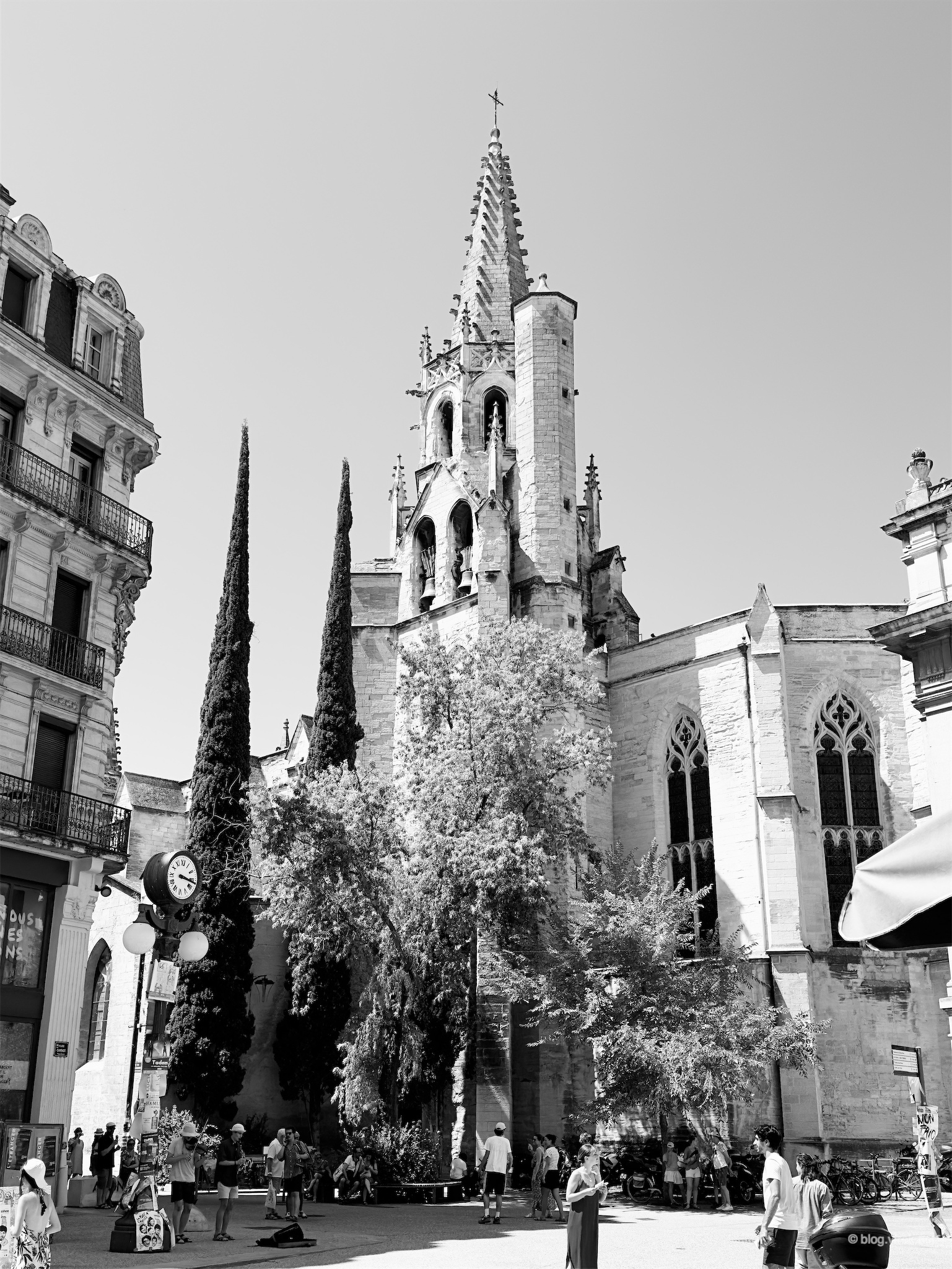
Entering the city, it was obvious why Avignon is considered a beautiful place to visit. The streets are narrow, full of character, and full of characters. After a short walk, I stopped at this square. The geometrical shapes of the spire, the trees and the onlooking buildings felt like a good opportunity. I’m a little shy and don’t like imposing myself too much, so this felt like a good loosener shot to try.
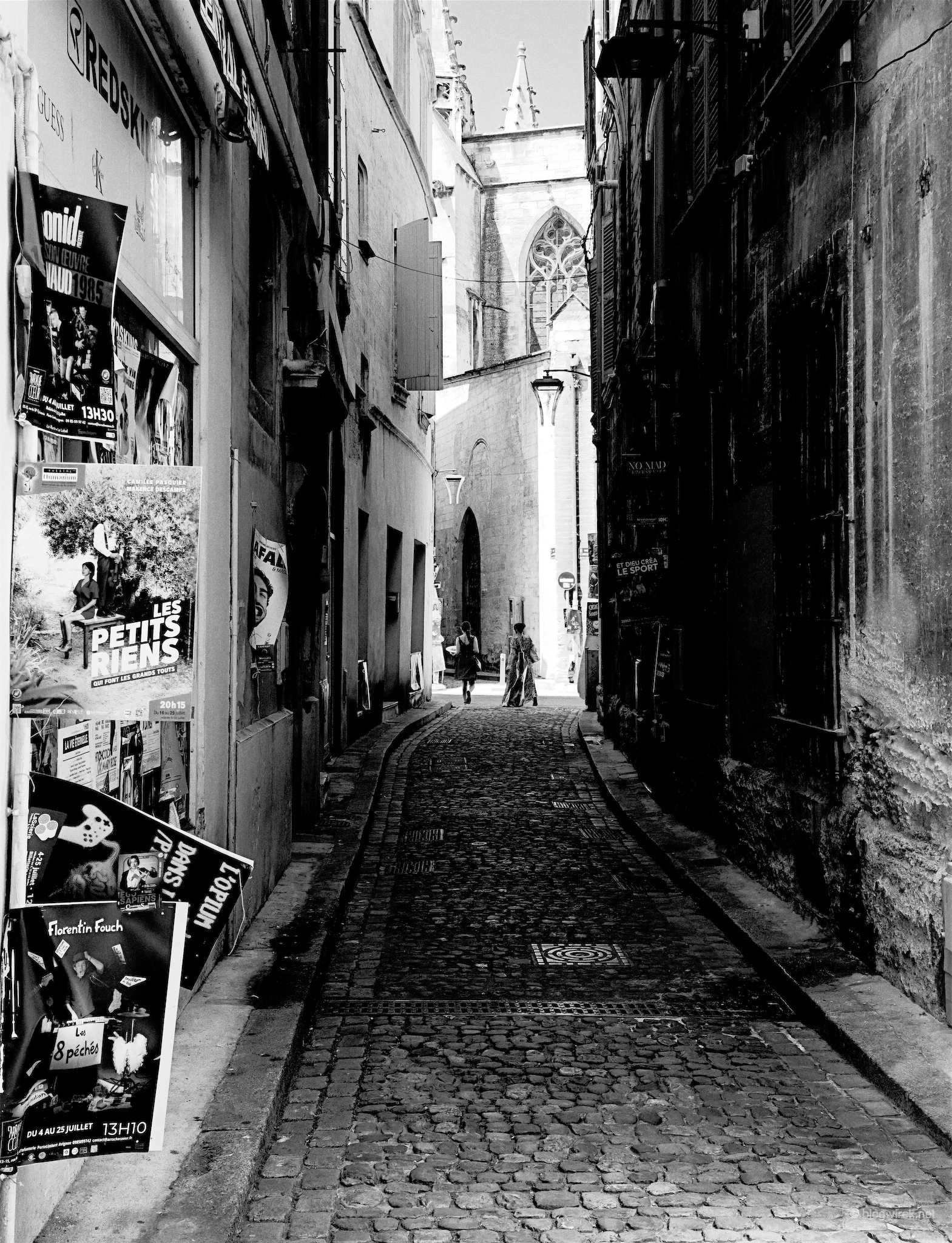
The beauty of Avignon is the myriad of small alleys and back ways that are all over the city. This felt like a good opportunity to take a photo with people, without breaching privacy too much. I liked the shadows and texture of this shot.
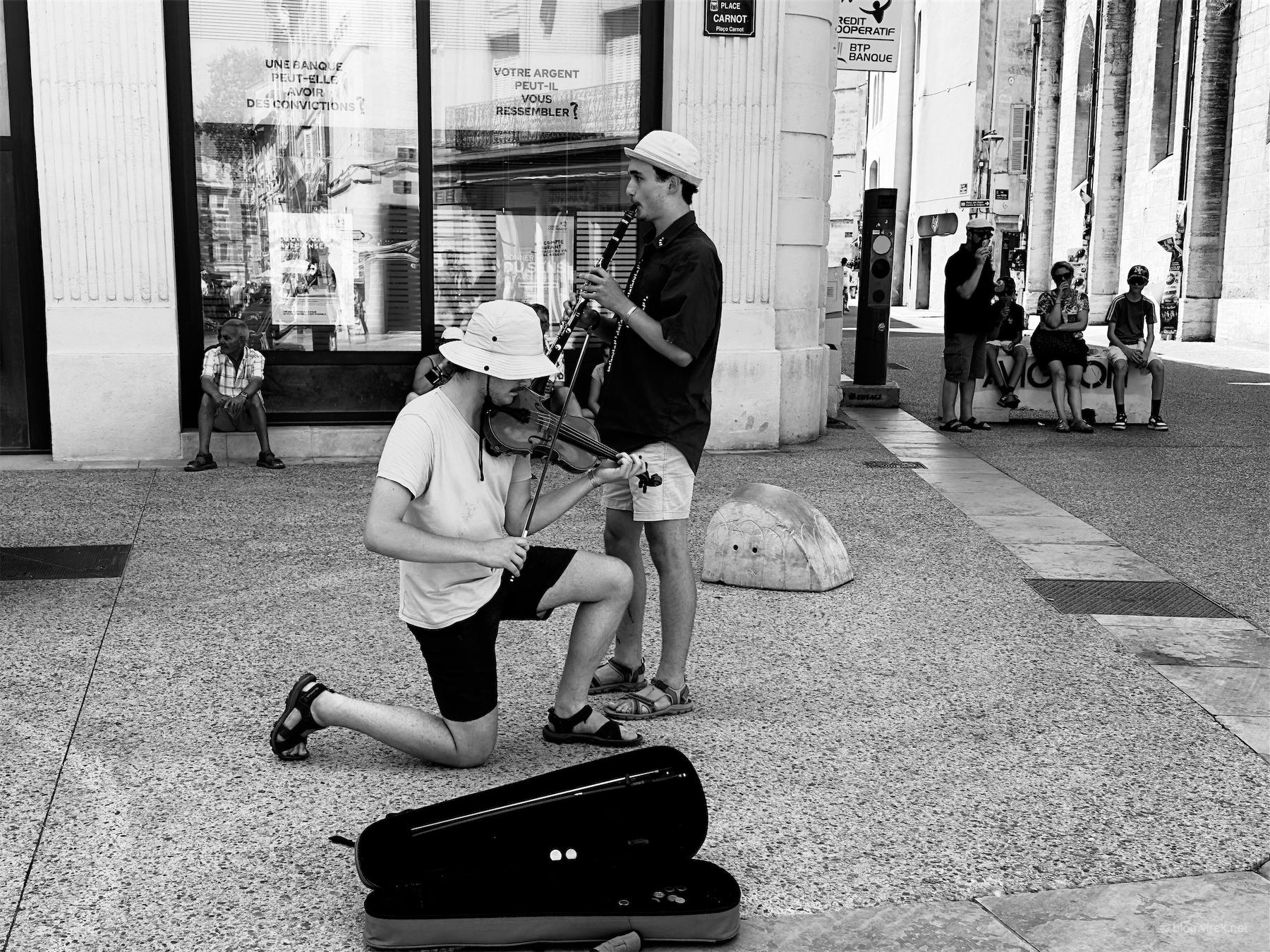
In another square, a couple of musicians were busking. They were also promoting that evening’s show in one of the seemingly hundreds of venues that were hosting performances during the festival. Sadly, I only had a couple of hours free, but I did drop a couple of coins into the hat as a thank you for them letting me photograph them.
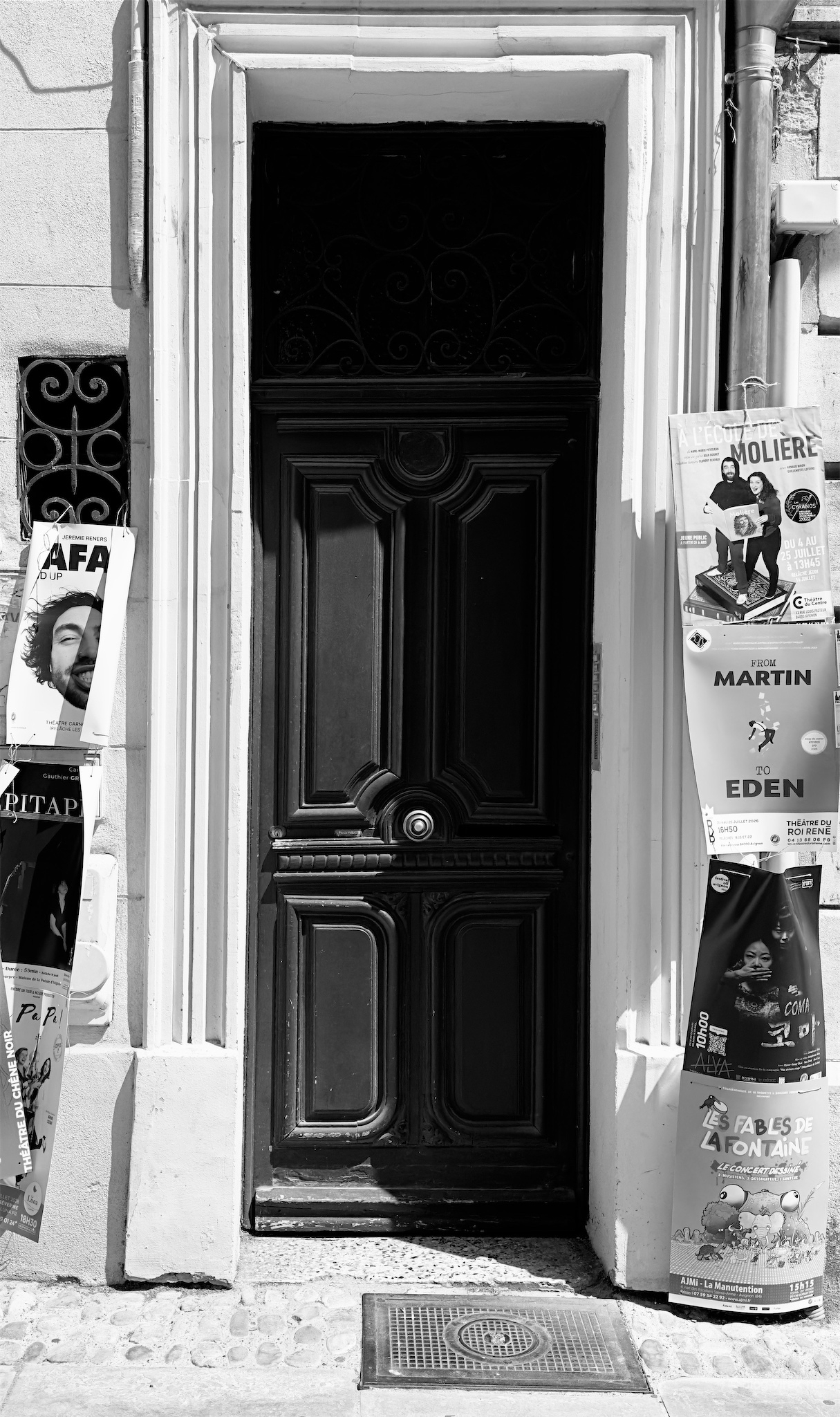
I don’t know why I looked at this door, or why it attracted me at the time. I think it was about the shadows. I liked the inverted L-shape of the shadow from the sun of the afternoon, casting a contrast on an already dark door. You can’t see it in black and white, but the door was virtually back in colour. I liked that it had posters all around the frame too.
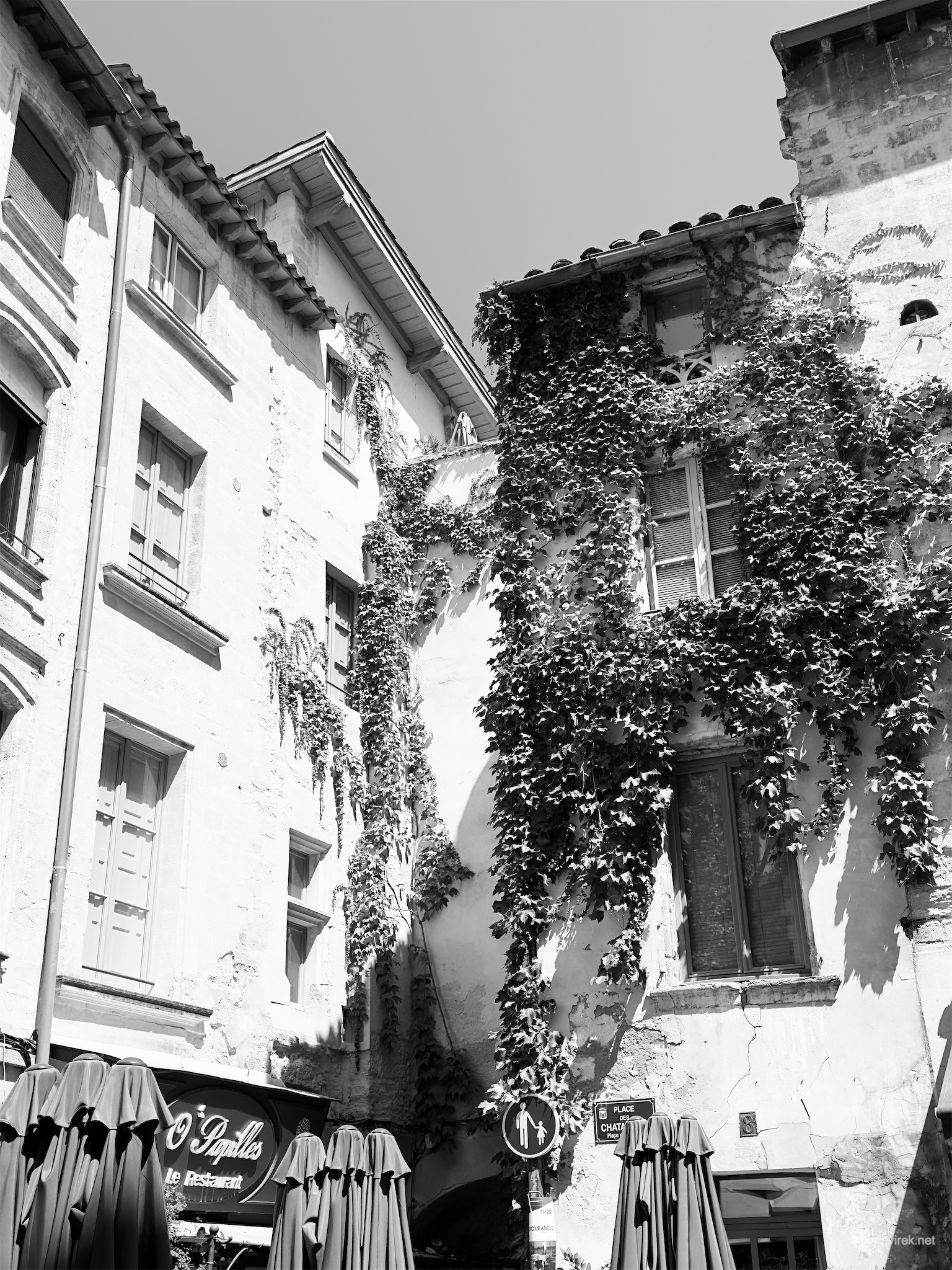
Another geometrically interesting shot of another corner of a square. Nothing amazing. I just liked the details, shadows, and shapes. The plants add another layer of texture that the walls of the building can’t, making for another interesting contrast.
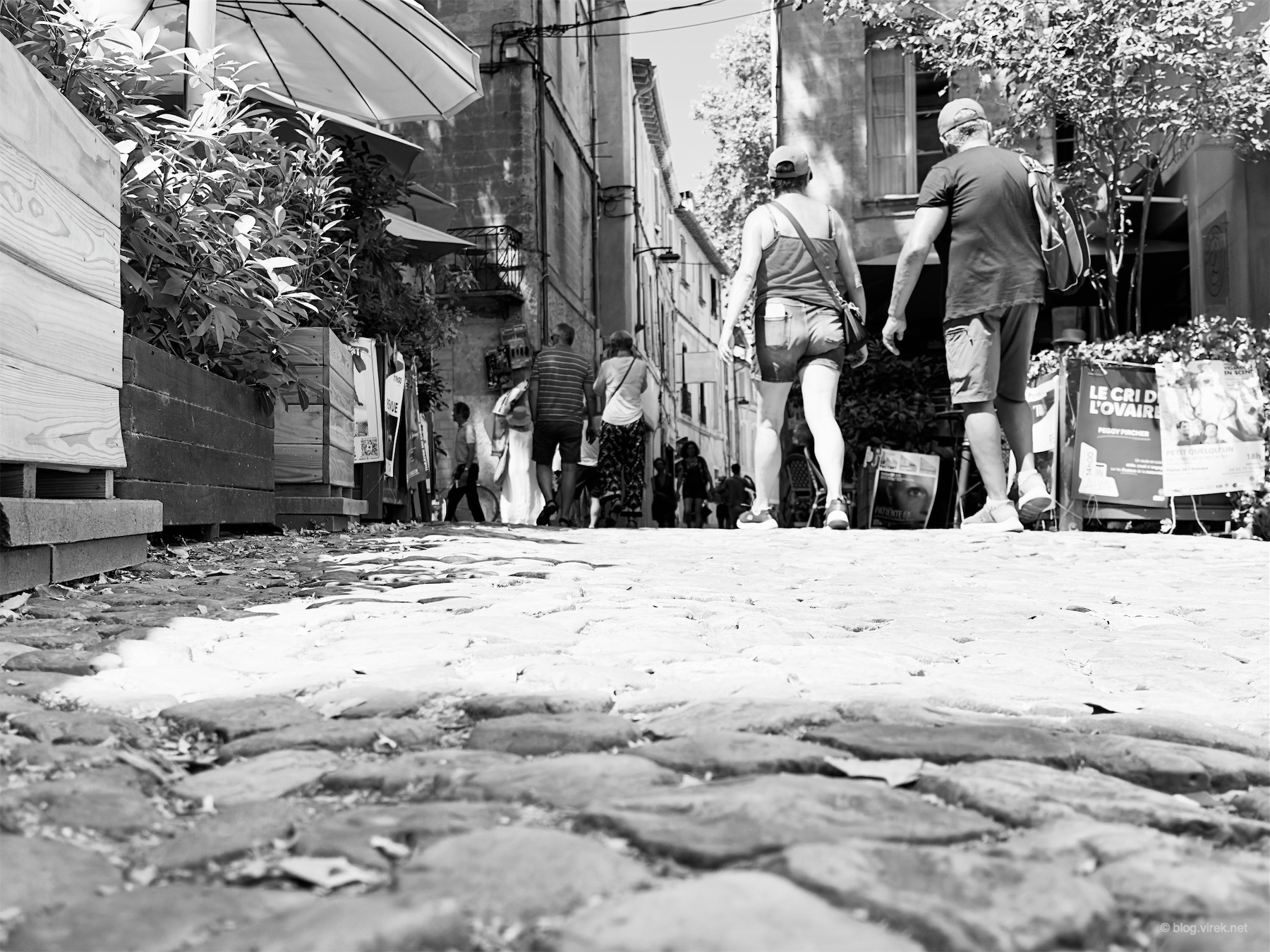
I’ve never tried this idea before. Namely, taking a shot from low down to emphasise the street and the cobbles. I think it turned out OK, but I think it is a little over exposed, washing some of that beautiful cobble texture out. Another edit might help. I’ll see.
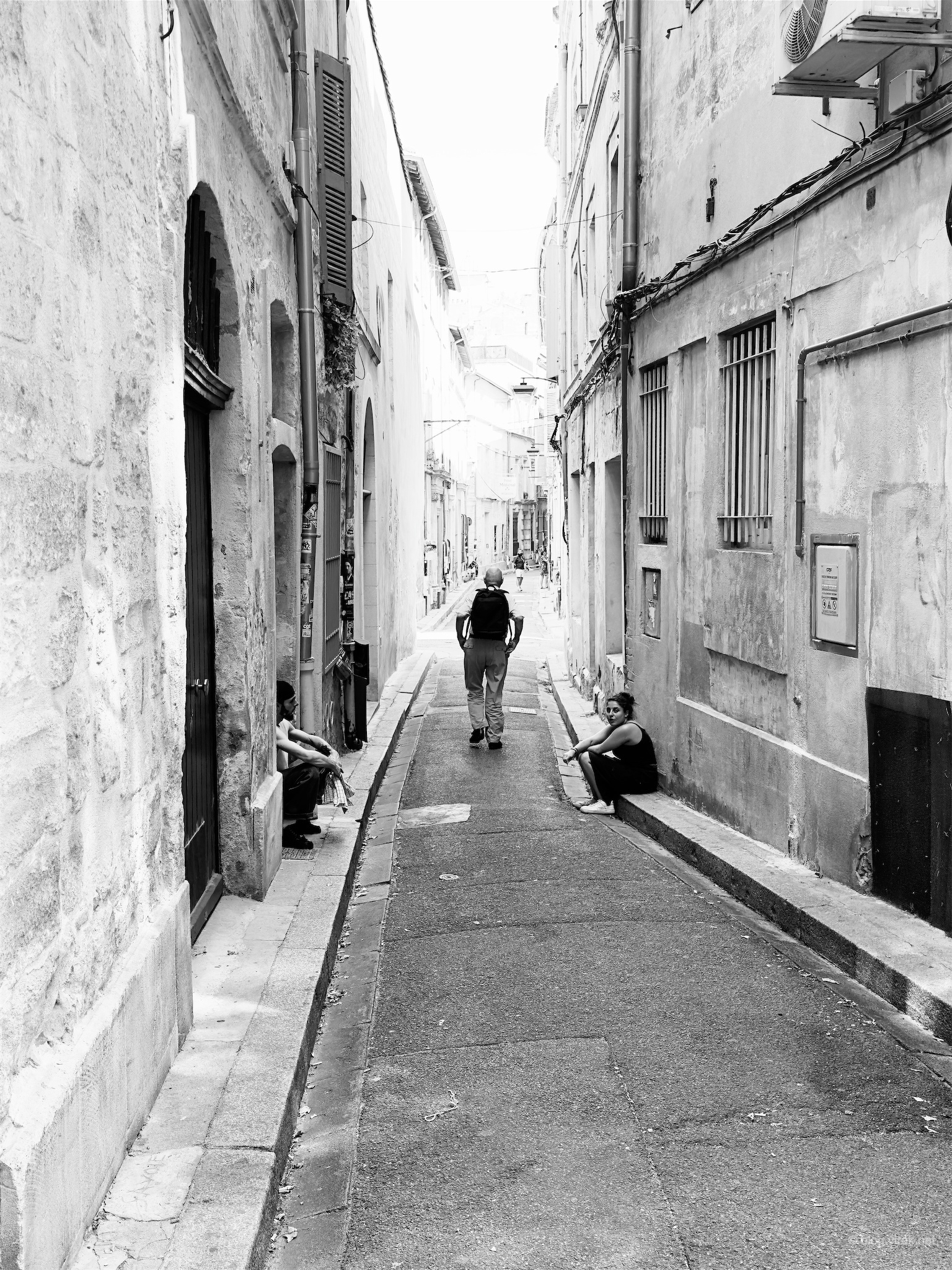
Another alleyway shot. This time, three protagonists. Each looking in a different direction. The gentle curvature suggests a gentle exit. The sitters were previously talking to the man leaving the scene, so I waited a couple of seconds for him to start walking before taking a snap. Luckily, I captured the moment the woman looked at me and her friend was still looking at her, whilst the gentleman walked away.
I really like this shot, but I think that a different crop, slightly tighter, could add more to it.
Once funds permit, I’d like to purchase a new camera, but that won’t be for some time yet.
I want a small rangefinder and am torn between a couple of ideas. Leica D-Lux 8, or a Fujifilm X100vi / Fujifilm X-E5 with a pancake prime.
If you have not been to Avignon, and you have the chance, you should go without hesitation. A lovely place, even if you have no intention of taking photos.
Everyone is a grifter now. And I fucking hate it.
If it’s not “merch”, it’s “Buy my course” (… on how to grift). It is “Go to my Patreon to get exclusive ‘content’”, who gives a fuck?
Have you seen the tidal wave of videos on YouTube (and other video services) that basically lie to your face about what they are?
“This one thing changes everything.” No, it doesn’t.
“Hilarious …” (mildly amusing).
“The truth about …” That’s a lie.
“The genius morning routine that changed my life”. No, it didn’t.
“First time hearing …”. No, it isn’t you liar.
“Game changing …”. Slight improvement on something inconsequential.
“… DESTROYS …”. Grow up, you fucking child.
“World’s best EDC setup”. Scouts is for kids (and trainee perverts).
Content creator has to be one of the most odious lies people tell themselves when putting out stuff on the Internet. You’re not a “content creator”. You’re not even a creator. You’re a cog in a machine that atomises and devalues you, your art, and all the people that might interact with you.
I fucking hate it.
Just when you thought that Mark Zuckerberg couldn’t possibly become a more odious specimen than he currently is…
Zuckerberg wants Meta to launch its own prediction market, report says
Prediction markets are the worst form of gambling that not only deliberately and systematically hide the consequences, funnel winnings to the top, buy they actively incentivise poor behaviour at the highest levels, with deathly consequences, creating self-fulfilling prophecies that have absolutely nothing to do with “prediction”.1 I doubt they are legal in Europe. But I also doubt we are not doing enough to ensure their cancerous nature is not expanding in Europe, which is already polluted (beyond repair?) by irresponsible and dangerous gambling sites.
We are in very dangerous times.
If you’re offloading meeting transcriptions to your ai of choice, you’d better be hyper-vigilant of the output generated, as it will inevitably attribute something it made up as your speech, and if it goes down in record you’re going to have a hard time walking that back.
It could cost you dearly.
The low-level anxiety that today’s tech causes is a problem that we should all be mindful of, and put in place strategies to deal with.
I used to be enthusiastic when a new tech product was announced.
Now I am immediately sceptical, looking for how it is going to lock me in, sell my personal information, trick me into ever-increasing payments, threaten me with DCMA if I dare to ‘modify’ it to my uses, … The list goes on.