
Essays
-
Those who committed the act were charged with vandalism, but ultimately the trial collapsed as it was, rightly, deemed as an act of political expression. ↩︎
-
I am purposefully not naming the application in this instance, as I don’t think it is helpful. But it also affords me the opportunity to highlight this case in broad terms and show that it is equally valable for a multitude of applications, developers and companies selling us things. It also shows that we don’t have to take it lying down and that it is we that, ultimately, have the power and that we should not be afraid to exercise it. ↩︎
-
↩︎Yes. You *serve* your customers. - Skimming / Getting up to speed
- Learning / Education
- Novels and Entertainment
I have a Frankenfax, and I love it
A few years ago, I was in Paris travelling and popped into a FNAC to grab something I couldn’t find on-island where I live. Whilst there, I had a look at books and stationary, as one does and I picked up a Moleskine Weekly Notebook with a week on one page and opposite a lined notes page. I’d been using digital tools to organise my work and personal life for years, if not a couple of decades, and I’d found that they hadn’t helped me enough to organise my chaotic brain and working life —I’d started a new company and lived through the shitshow that was COVID-19. So a physical diary was an attempt at an antidote.
I’d owned a real Filofax in the late 80s and early 90s, and I remember it being useful and practical, but no more than that. As the Moleskine was to hand and reasonably priced, I took a shot at using it daily for planning, replicating the data into my digital systems. This dual-entry was actually helpful to anchor the things I needed to track, plan and execute. And so I’ve stuck to it ever since. For the following years, rather than getting a replacement, I opted for LEUCHTTURM1917 diaries. Again, week on the left plus lined notes on the right. This disposition seems to work for me as I can plan appointments on the left, write tasks on the right, but also add notes and other thoughts quickly on the open pages, so they are visible for me during the day. This visibility is important and the Achilles’ heel of digital systems on phones and tablets. No longer in sight, no longer existing. Additionally, at the back of the LEUCHTTURM1917 there are a few notes pages for longer notes and other stuff I might want to jot down. Having two ribbon page markers allows visual clues to there being ‘other stuff here’ was also an upgrade over the Moleskine.
And then I started to get interested in ring binders, à la Filofax. I liked the flexibility that I could add only the things I need, as an advantage. Additionally, I’d started to see numerous projects to self-print inserts, allowing me to create my own personal setup, without being beholden to the printing schedules of the manufacturers. I stumbled on a site called Philofaxy and thought I’d try out the free-to-use inserts available there. But firstly, I required a ring binder. I hopped on Leboncoin (a French sell-your-old-crap site) and found a sale locally, on the island, for a genuine Filofax A5 Metropol in faux leather. For €10, it was a no-brainer. So after a little organisation, I had it in my hands, and it was in near perfect condition. The seller kindly gave me a few other items like paper and dividers too so that was a bonus.
So my experiment began. I printed out the inserts I wanted after modifying the Word template to my tastes, and added the (kindly) supplied-in-the-sale note paper and started using it alongside the LEUCHTTURM1917 (together with the digital tools). Slowly, I noticed that I gravitated more towards the Frakenfax, seemingly confirming the experiment, eventually ditching the LEUCHTTURM1917.
I have a brief essaie with tabbed dividers, both commercial and self-printed downloads on 120 gsm paper, but I just couldn’t get used to them. I don’t need to separate the binder into topics, only types (diary, notes, annual planner). So I decided to make my own page markers, again, out of 120 gsm paper. I cut them to about an inch wide and ensured they were taller than A5 and wrote “Today”, “Notes”, “Planning” at the top and was happy with that setup. For a few weeks. Unfortunately, unprotected paper does take to being pulled left and right much, and I didn’t have any hole strengthener stickers (remember them?), so they started to look a little too rag-tag, even for my tastes. So I ordered three official Filofax A5 black ruler / page marker (343609) to fulfil the same role.
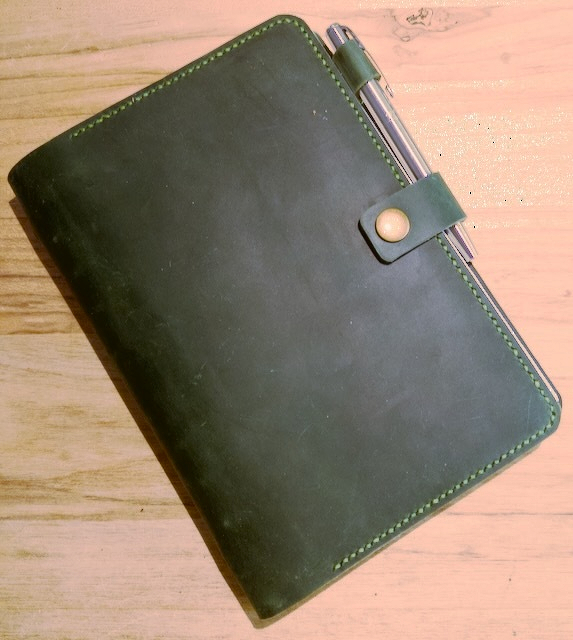
At the same time, I felt that the physical size of the Metropol was a little like putting an XXL jumper on a body of a petite corps. Additionally, the pockets and business card holder slots were superfluous to my requirements and so wasted. Looking on Etsy, at a shop I’d already used to order some leather notebook holders (DM Leather Studio), I wanted to get a leather binder rather than the cheap-feeling faux leather. I ended up ordering a green leather A5 binder and received it a couple of weeks later.
Transferring all the inserts, the page markers, and adding a Parker Jotter fountain pen in stainless steel into the pen loop felt like I reached the goal that I was hoping for. Even though the binder is A5, it is more proportionately sized for A5 inserts and looks better than the Filofax. It feels so much nicer to use daily. If I have one complaint, it is that the binder’s rings are a little tight at 15 mm, but its enough for what I need and helps ensure I don’t stuff the thing with too much crap. Given the ring mechanism is easily replaceable, I might look into replacing them with some slightly wider ones in the future. But that’s another project and not urgent.
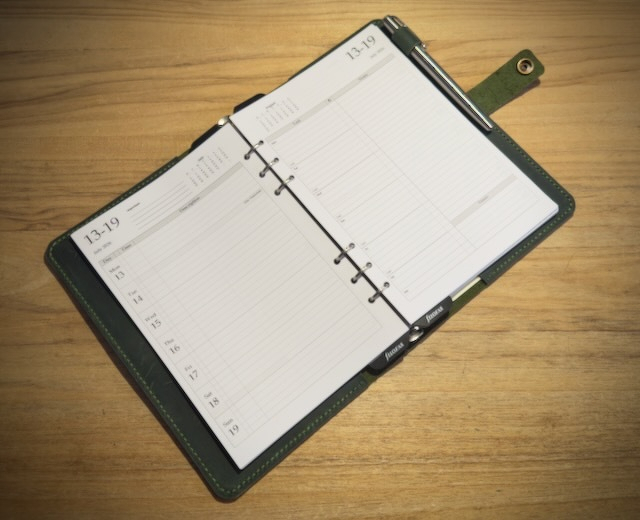
So there it is. My Frankenfax cobbled together from a handmade leather binder, modified self-printed diary inserts, official Filofax note paper and Filofax page markers.
It’s almost perfect!
Avignon : A photo essay
I spend far too much time reading. Reading books, articles, blogs. So much so, I don’t produce enough of my own stuff. So, inspired by a blog I just read, I thought I’d write a quick photo essay.
Recently, I had to make a journey to Avignon in the south of France. One day, I was at a loose end, and being not far from the center, and it also being the festival of Avignon, I took a couple of hours to have a walk around the old town and take a couple of street photos. I’m not a photographer, and I don’t have a decent camera any more. So the shots were all taken on an iPhone 14 Pro. Not the greatest in the world. To make things more interesting, I decided not to deviate from the default focal length and shot in black and white (set in the camera app), but in DNG in case I wanted to have an image in colour. All the photos have been cropped and only lightly edited to bring out shadows or highlights.
I like the idea of self-imposed constraints to try to force me to look harder for more interesting images and place myself more thoughtfully when taking a shot.
A local had given me a tip about where I could park for free and take a free park-and-ride bus that would drop me off near one of the ancient entrances to the fortress city. I was so close, I could have walked. Which is what I did on the way back.
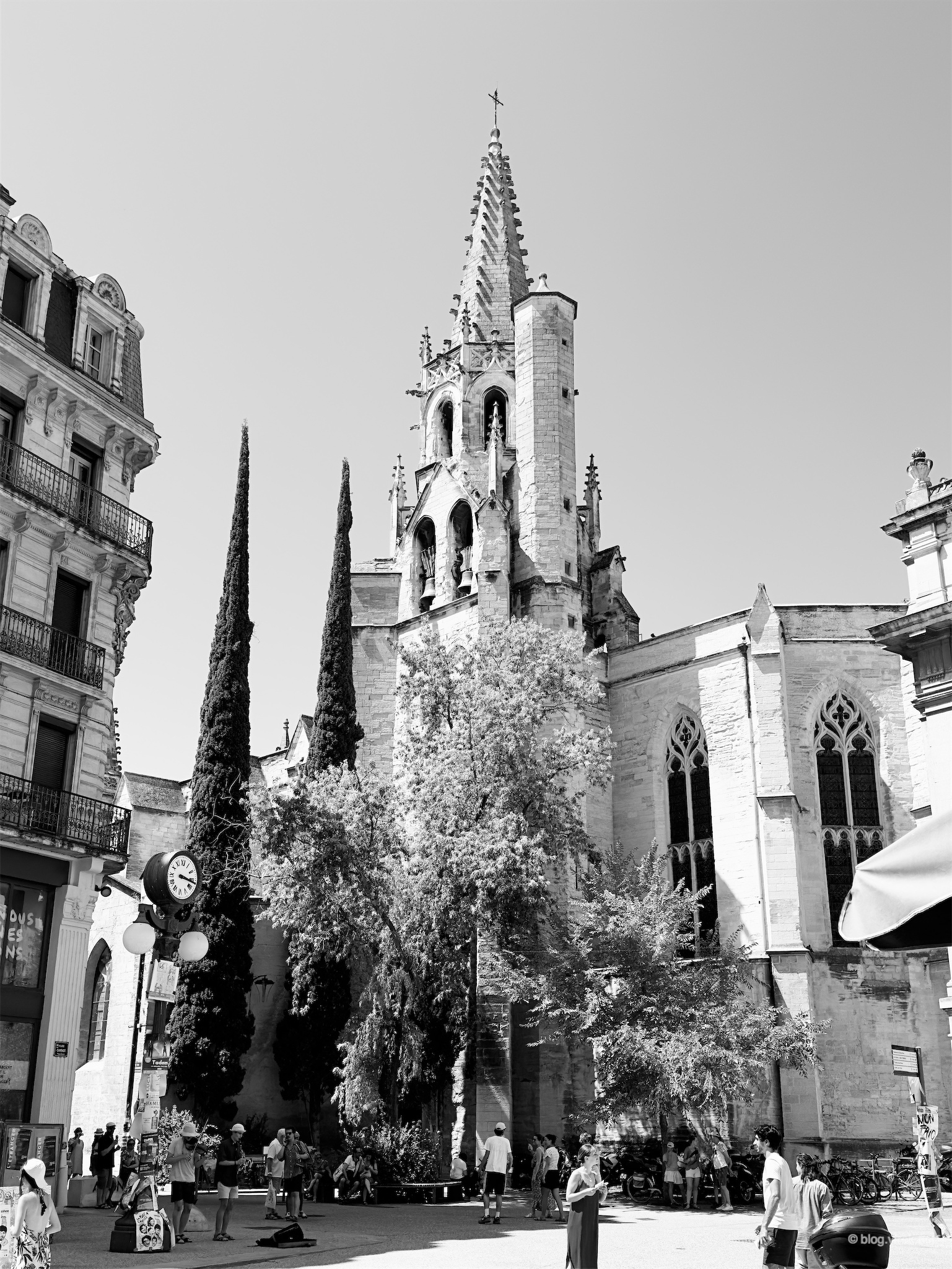
Entering the city, it was obvious why Avignon is considered a beautiful place to visit. The streets are narrow, full of character, and full of characters. After a short walk, I stopped at this square. The geometrical shapes of the spire, the trees and the onlooking buildings felt like a good opportunity. I’m a little shy and don’t like imposing myself too much, so this felt like a good loosener shot to try.
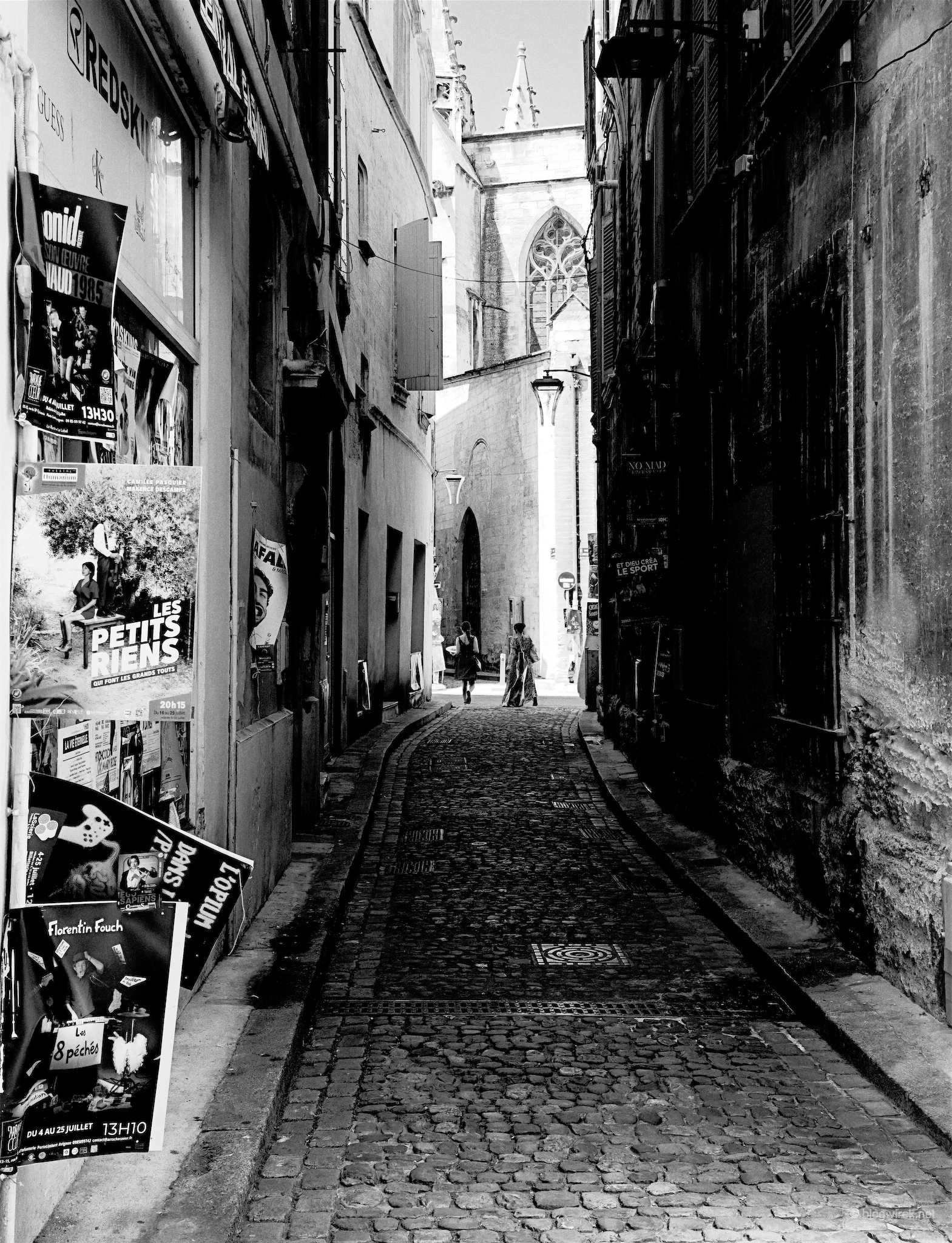
The beauty of Avignon is the myriad of small alleys and back ways that are all over the city. This felt like a good opportunity to take a photo with people, without breaching privacy too much. I liked the shadows and texture of this shot.
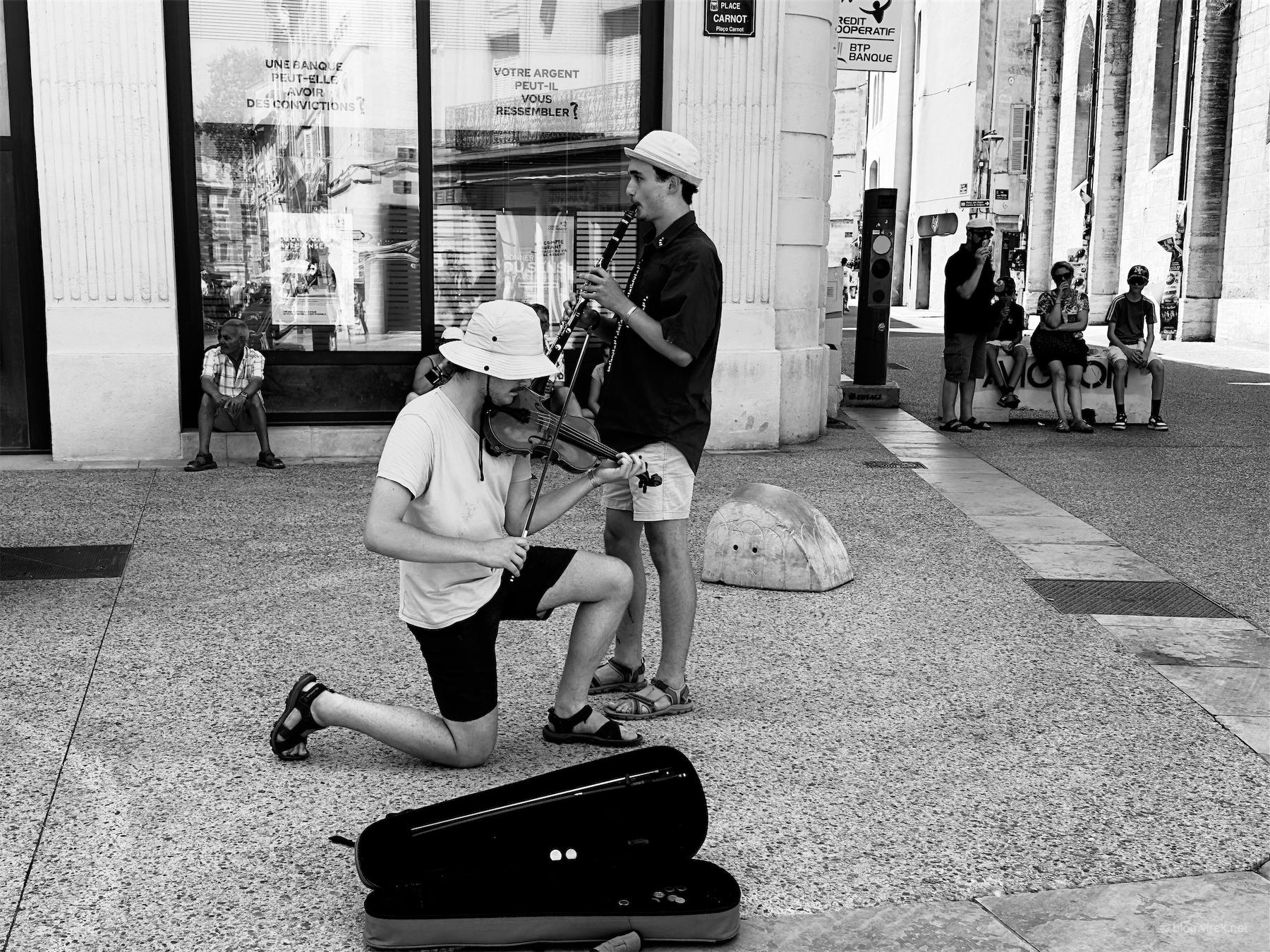
In another square, a couple of musicians were busking. They were also promoting that evening’s show in one of the seemingly hundreds of venues that were hosting performances during the festival. Sadly, I only had a couple of hours free, but I did drop a couple of coins into the hat as a thank you for them letting me photograph them.
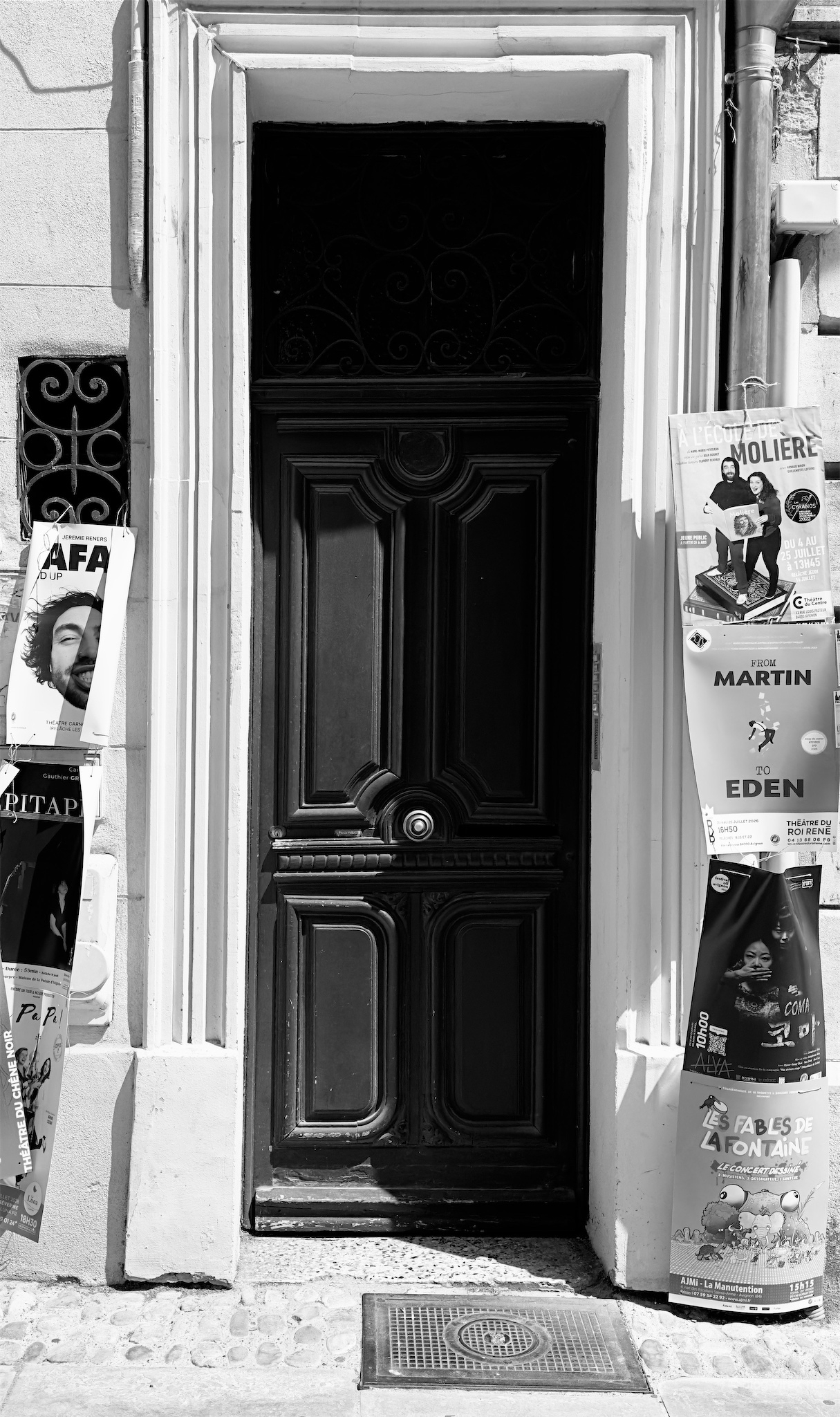
I don’t know why I looked at this door, or why it attracted me at the time. I think it was about the shadows. I liked the inverted L-shape of the shadow from the sun of the afternoon, casting a contrast on an already dark door. You can’t see it in black and white, but the door was virtually back in colour. I liked that it had posters all around the frame too.
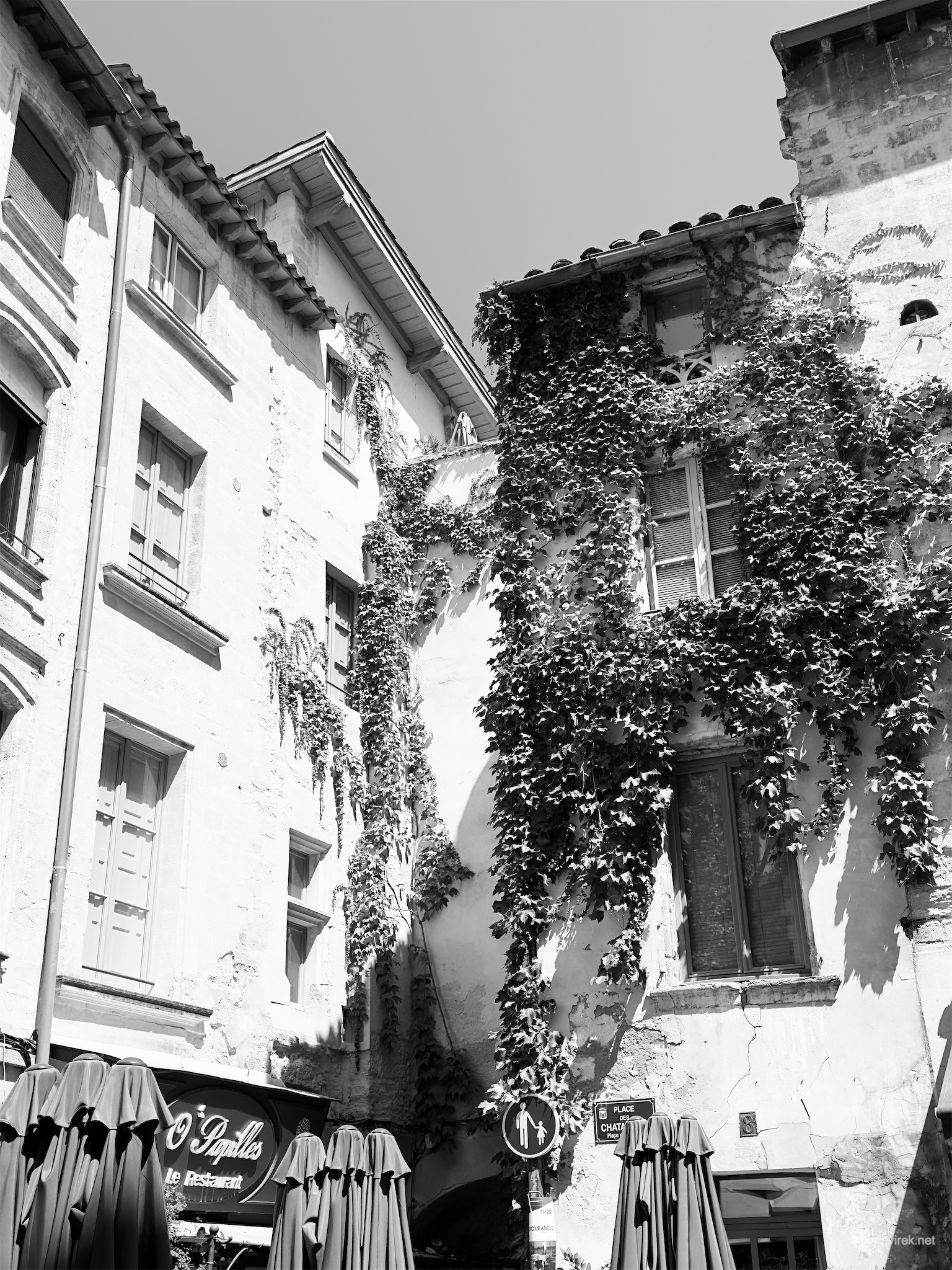
Another geometrically interesting shot of another corner of a square. Nothing amazing. I just liked the details, shadows, and shapes. The plants add another layer of texture that the walls of the building can’t, making for another interesting contrast.
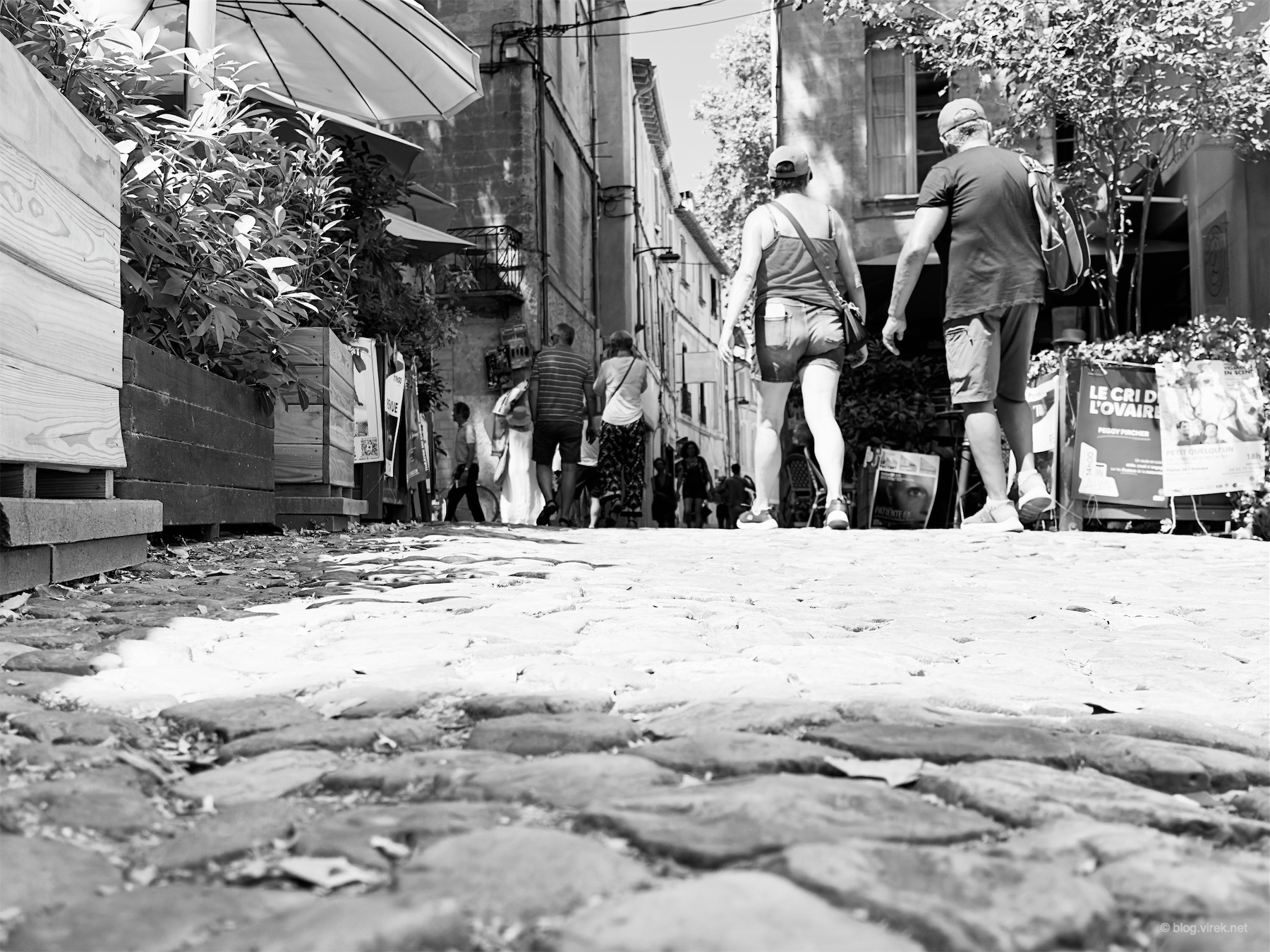
I’ve never tried this idea before. Namely, taking a shot from low down to emphasise the street and the cobbles. I think it turned out OK, but I think it is a little over exposed, washing some of that beautiful cobble texture out. Another edit might help. I’ll see.
Another alleyway shot. This time, three protagonists. Each looking in a different direction. The gentle curvature suggests a gentle exit. The sitters were previously talking to the man leaving the scene, so I waited a couple of seconds for him to start walking before taking a snap. Luckily, I captured the moment the woman looked at me and her friend was still looking at her, whilst the gentleman walked away.
I really like this shot, but I think that a different crop, slightly tighter, could add more to it.
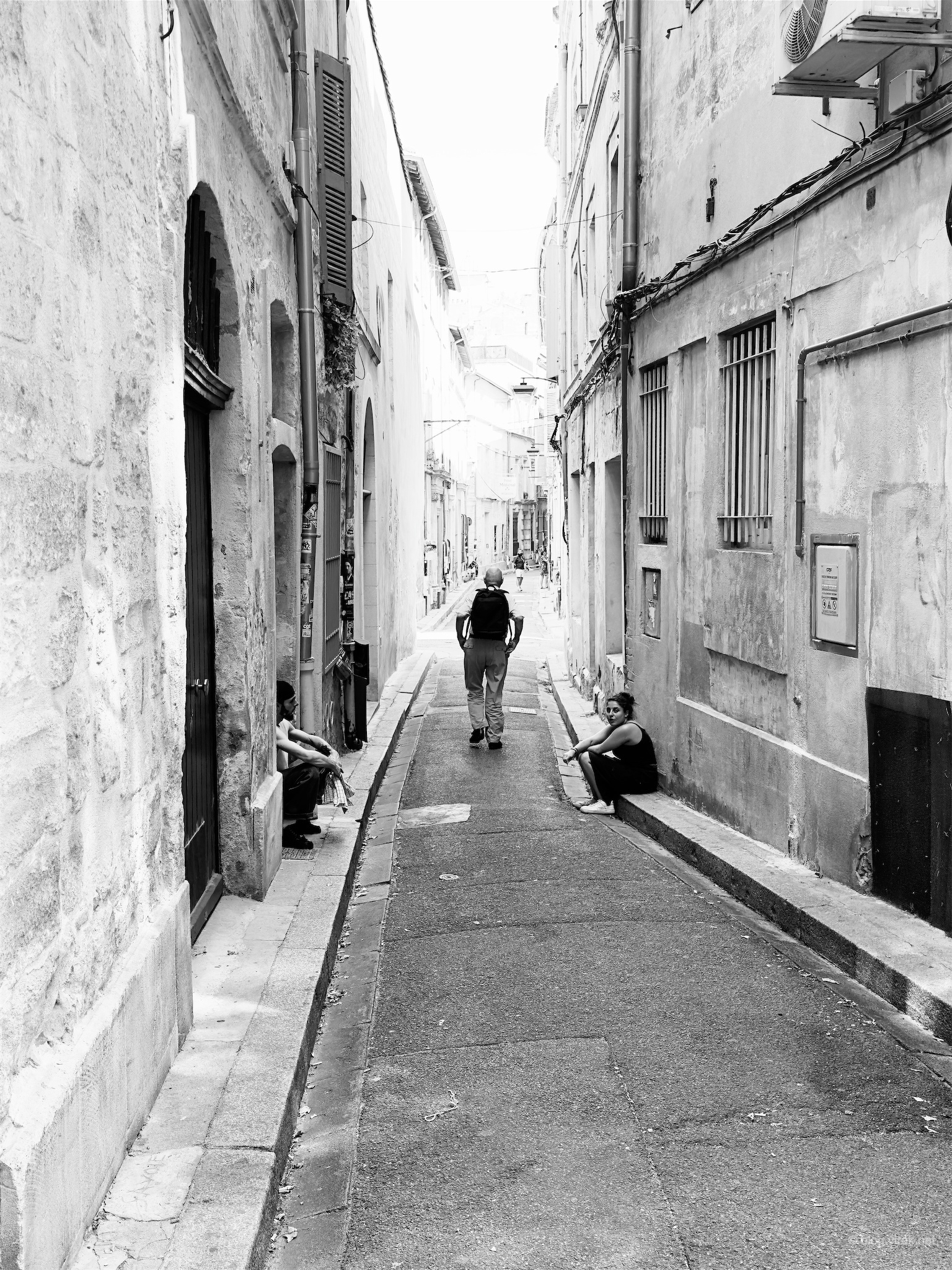
Once funds permit, I’d like to purchase a new camera, but that won’t be for some time yet.
I want a small rangefinder and am torn between a couple of ideas. Leica D-Lux 8, or a Fujifilm X100vi / Fujifilm X-E5 with a pancake prime.
If you have not been to Avignon, and you have the chance, you should go without hesitation. A lovely place, even if you have no intention of taking photos.
The Silicon Valley types, along with the tech bros, are showing us that they are actively trying to re-instate slavery, through robotics and Agentic AI. It is a demonstration of their disdain of anything that isn’t of their class and their need to be “served” anything and everything, at anytime. It exposes their belief in an imaginary hierarchy of society and the logical conclusion of the Ayn Rand philosophy of individualism put in practice. It is a violent assault on humanity. Welcome to the Digital Plantation.
In Martinique in the 19th Century, a statue was erected to celebrate the life of Napoleon Bonaparte’s wife, Joséphine de Beauharnais. She was born on the island into a rich slave-owning family. Slavery was not her fault. Of course, she had no choice into which family she was born. But she decided to do the unthinkable. She lobbied for, and obtained, the re-instatement of slavery on the island in 1802, when slavery was about to be castigated in the dark annals of history of the island. She, and her cohorts, couldn’t imagine a world without slaves doing anything and everything for her, at anytime. Of course, the fruits of that forced labour were purely for her and her families’ profit. At great pain and expense of the forcibly expatriated and enslaved Africans.
A crime against humanity warranted a statue in her name, apparently.
It was beheaded one day in 1991, and was left in this state for over a decade. Then, on another day, red paint, symbolising the blood of the people she personally enslaved, was smeared on it. Until its ultimate fate was decided, as it was toppled and damaged beyond repair, in what any decent human can only describe as a fitting final act for a symbol of entitlement, inhumanity, and violence.1
Like the old slave masters, the broligarchy will end at some point, possibly even violently. Statues or symbols of their power may be erected both physically and digitally in this time, that symbolise their power and privilege, and boast of their prowess. But they too will be toppled and destroyed.
Growing up around a museum
When I was very young, I have a couple of distinct memories that have since faded somewhat, but they are still there and appear when something triggers them. The trigger in this instance was my stumbling on the IndieWeb Carnival March 2026 : Museum Memories. It was going to about one of those memories recanting my chance relationship to one of the most interesting museums in the UK, the Science Museum in London. My elder brother was school friends with the son of the director of the Science Museum at that time, and a memory of our two families strawberry picking and then eating lunch at their house. It was where I first tasted Spaghetti Bolognaise. The memories came flooding back to me when I read the subject.1 But I think a more interesting story about my memories of a museum is to be told.
I grew up in the 70s on a modest housing estate in the West Midlands that was located not too far from what has been called the Birthplace of the Industrial Revolution. Throughout my early years, it was common to have it drilled into us that Ironbridge and the surrounding area was the most important site of industrialisation in the entire world.2 There are several sites, museums, and artefacts that testament to the history of the area that we could avoid nor miss. However, like most kids of a young age, I grew up with a complex mixture of pride, interest, and total ambivalence to the evidence that was within my field of view permanently. Sure, some of it was interesting, and it got us out of school on a number of occasions to benefit for some fresh air, but historical acts of smelting iron ore were not the kind of thing this young lad was interested in.
But from a very early age, I got to experience the entire museum complex, not as a visitor or patron, but as a result of other circumstances. Allow me to explain.
Before I entered infants school, my mother had struck up a friendly relationship with the potter at Blists Hill, part of the Ironbridge Gorge Museum, some time before its opening in 1973. She was a creative soul, with much place in her life for the enjoyment of expressing that creativity. We would often walk down to the museum, following the back roads, through woodland pathways built on old mining slag heaps, round the back of the posh people’s houses and down the hill to spend a few hours in the pottery. Probably a good fifteen-twenty minute walk. Once onsite, I was given a lot of freedom to roam around and look at the various shops and interests of the site, and then we’d go home for lunch. The site, it is a reproduction victorian village, with shops, banks, and other artefacts that faithfully recreate the era. It was fairly rudimentary in those days, having not long opened, but quickly developed into one of those rare but popular destinations where you get to not only see, but touch, smell and really feel the past.
Roy, the potter, was a very kind man. He’d known me before I could walk, and later as I was a little older, he let me run around the pottery as long as I didn’t go near the ovens! He took time to show me how everything worked, giving me lessons on spinning, glazing, and firing. It was fascinating because it was real. Physical. Tangible. It was the job, of course. Something he’d do for paying visitors, but I could tell he did it for the pure joy of being able to transfer his skill and knowledge. He is a skilled potter and had no trouble selling his creations. He still works as a potter to this day.
A few years later, I’d grown a little, and was now struggling in secondary education (for reasons), but had one thing that I could do well without constantly fighting against myself. Music became a central part of me and, most probably, a life-saver. That love for music started as a youngster, my mother would take me and my siblings to the “big school” on Saturday mornings to make bamboo recorders. Spending weeks cutting, filing, drilling and carefully placing a piece of gently cut cork to make a sound that was all of your doing was enchanting. Several weeks would then be spent attempting to tune the recorder, all while learning to play basic music. I learned about music at this stage, and it affected me profoundly. From a failed attempt to learn the violin, through the bamboo pipes, I eventually fell in love with an unassuming brass instrument, the B♭Cornet. I became a very good player for my age, and had a very good maitrise of three variations of the instrument. The Cornet, an E♭Soprano Cornet —which is much harder to play—, and a B♭Trumpet. I became one of the key players in the school band, sharing “principal” responsibilities for a number of years. The school band gained a notoriety, and we were often playing around the country on weekends, in a sponsorship with British Rail (back when it was a company for public good) in various towns and cities, including the local museum sites in Ironbridge. I got to see the museum once again for free, but in very different circumstances. The various sites of the museum hold a special place in my memories of a time that things were not always plain sailing.
I now live many millions of metres from the museum, but I do think about how much the museum has been present at various stages of my life.
You built the absolute best app in its field.1 The most useful and helpful to use with a genuinely delightful interface, all for a reasonable price that fitted so perfectly into the category that you practically single-handedly owned the space.
True, it was a relatively small market, but you were making a healthy profit and were highly respected by the large group of users you served.2 So much so, users would volunteer help and advice, knowing that their contributions would be taken seriously and possibly even further developed and integrated into the app for the benefit of all.
Given that your app is a security app, this invaluable feedback helped ensure your app didn’t falter badly like others in the same category, the category you essentially created.
But you couldn’t leave it there, could you?
The lure of MOAR just kept eating away in your mind. Eating like a cancer, growing unseen and undetected until it made itself inextricably embedded.
But unlike the classical treatment of a cancer, and contrary to all knowledge on treating cancers, you decided to embrace it. And embrace it you did. You went off and got that big fat cheque of VC money to expand into “new markets” and into new profits.
For a while, it looked like you had managed the change, and that the mission was the same. The expansion into that new market felt very much like the first foray into bringing the goodness to those on the other platform. I even recommended it to numerous people using the dark side’s platform. But now we know, it was only the cancer directing you to give it more food for growth. And it didn’t take long for the cancer to start attacking the more sane and reasonable parts of the organisation. It always does. That’s what a cancer is. You can’t embrace it, for it will embrace you. It will consume you. It always does. And there is nothing you can do about it once you have left it embed itself so deeply. I know what I’m talking about. I have lived through what a cancer is and what it does. That is why I recognise it, in all its forms.
Then you sent us all an email, explaining that you were “upgrading” your prices (our costs) by 25%. Justifying the move with the fact that you hadn’t increased prices in a long time. Adding that, you were adding functionalities that no one asked for. Functionalities that could potentially result in substantial in cost increases for you.
Firstly, who wrote and signed off on using the word “upgrade” in this context? I would suggest that you purchase a dictionary for them to use, and then systematically double-check any public communications they may make in the near future. It smells (badly) of a press release copiloted by a stochastic parrot. Should that be the case, something we’ll probably never know, the fact that you treated the most important part of your business; hint: your customers with this disdain, suggests that going forward, you will treat us at least as badly, but more likely worse. Let alone the disregard for our data you may have in the future.
Secondly, this was your strategy. Not ours. You decided to use the injection of VC money to stabilise prices, not us. Instead of incrementally pricing as functionality was introduced, or as inflation required. Now it’s our fault? You didn’t even offer an option for those that only need basic functionality to stay on a plan similar to the current one. It would have been less than ideal, but not as egregious as this agressive threat expressed in that rueful email. No. You went for the nuclear option and told us all that you had us by the balls and that the ransom starts now.
So let me be clear, and I want to make this as unambiguous as possible. Go fuck yourselves!
I will be “upgrading” my use of your application, rendering it superflus to my needs.
For the record, my short interaction with the support team, has clarified that you simply do not seem to understand the problem.
So long. And thanks for all the fish.
Last year, I tried to be a bit more intentional with reading. In some respects, I was trying to get back to a time when I would always have a book on me and would read it throughout the day, on public transport, in the office, or whilst waiting for something. It is an activity that I have lost and missed, and, I think, to many other people since the attention capture of Social Media.
I largely achieved that goal, and it has been good for the soul, but I’m sure that I could have done better. I’m largely off anything social, although I read a few posts on —non-nazi bar— forums and Mastodon. But it got me thinking about the types of reading I do and how I can fine tune the intentionality for (hopefully) better outcomes.
If I had to categorise the types of reading I do, it tends to fall into one or more of the following bins:
For the first type, I am starting to limit myself to a maximum of an hour over a full twenty-four, to catch up on posts on Mastodon and news-related sites with NetNewsWire’s fine RSS reader. This is high sugar content that satiates a need in the instant, but quickly dissipates from my brain, leaving room for other things. It used to be MOAR of the same, but this is a habit that I am slowly kicking. But damn, the world going to hell in a handbasket is really not helping!
For learning, this is highly intentional reading, where I will need to set aside time to read, re-read and digest the information. Within this category, there are probably a couple of other subtypes. For example, for training materials, I tend to read quickly, take a couple of notes to get the gist, re-read then take the test / exam. This serves me well, and I generally get high grades. For other writing that is ostensibly something I’d like to “learn” something from, I have a tendency to read it, think I’ll remember it, and of course don’t. Typically, this is on personal blogs of writers, or others sharing on a topic that interests me. It’s not formal training, or journalism, but it is nonetheless interesting and helpful to developing one’s particular interests. The change this year —if I can achieve it— is to treat it more like education and take notes. Even if these notes are not extensive, structured and written with poor handwriting skills. They might never be seen again, but that doesn’t matter because the exercise of effort to write them in the first place is likely to have a positive effect on retention and learning capacity.
For novels, I want to get back to the wonder I felt when reading books when I was younger. I’ve never been one to take reading notes and write my personal summaries. Whilst I aspire to that, I don’t think I’m wired that way, so I’ve decided not to fight against it. I’m going to read them. Enjoy them. Finish them. And then move on to the next book. This doesn’t preclude me from taking an interesting note at some point in the future, but I’m not going to ‘intentionally’ start reading a book with the purpose of producing reams of notes. And, to be honest, I have a fairly unique relationship to novels, in that I cannot re-read them in the future, as I already know the story and what is about to happen that it kills all the joy for me. I can count on one hand the number of novels I’ve re-read over my life. I just can’t do it.
I’ll see how I get on this year and in trying to keep myself on track, I’ll return to this post every now and again.
In defence of Stage Manager
Judging by public reactions, this is not a popular perspective, but I, for one, am grateful that Stage Manager exists, and I use it almost exclusively. To be clear, I only use it on macOS and don’t go near it on an iPad as it is not fit for purpose on that platform, sadly.
On the Mac, it is a tool that I use to help me with distractions, helping me concentrate on the task at hand and avoiding the distractions of the constantly updating timelines, documents open that require edits, or the myriad of other distractions presented by modern computer interfaces.
With ADHD, it is a constant battle to stay on track and to keep enough focus on the current task alone, that any assistance is helpful. For me at least.
It is not without its problems, however. Some applications don’t behave well. Excel is a good example. If you have two workbooks open in two different Stages, operations like undo jarringly flip you to the other stage and the undo is ignored completely. I’m sure that Microsoft are totally on top of this, and it’ll get fixed in about ten to twenty… years!
For now, I’m sticking with it and I turn it off now and again when I don’t have the need to focus as much.
While I think of it, one good example of this is when I present. Presentations don’t sit well with Stage Manager and simply and quickly turning it off makes the presentation work fine.
There are other improvements that could be made, like remembering groups of apps between sessions and reboots. I’d like to be able to designate what goes with what in which Stage to always open the apps concerned like that.
As I said, in defence of Stage Manager.
17 March 2025 — French West Indies
Blogrolls are cool again
I’ve tried blogging on and off for years, possibly decades. It has never stuck. These last couple of years or so, I have been more consistent and blogged a lot more.
I’ve had to move platforms, so much of the old stuff is badly linked these days, and I even had a post promoted by a software house mere days before I moved platforms again, rendering their link to my blog useless 😰 —I didn’t have the heart to ask them to update the link.
One thing that stuck out in the later stages of the earlier blogging period was a list of recommended blogs that bloggers would share on their posts/pages. It got a bit nepotistic eventually, but the idea was solid —You like my blog, why not try these?
They died out when microblogging sites like Twitter and other social media walled gardens railroaded the Internet. The algorithm replaced the recommendations, not to help you find more interesting things to read and learn about, but to monetise you through invasive and often illegal advertising malpractice.
But blogging is making a comeback. People are starting to feel the real harm social media is doing to us. And yes, I know there are studies that say there’s nothing wrong with social media, and others that feel it is literal digital cancer. The truth is probably somewhere in the middle, or at least more nuanced than those arguments —that are, by the way, very “social media” in construction by being as binary as that.
And so with (real) blogging making a comeback, so are blogrolls. These are the real algorithms of the Internet. One’s that are much better, much saner, less clickbait-y… more human, and humane.
Long live blogrolls. Mine is a work-in-progress, and you can find it from the menu.
2 May 2024 — French West Indies
Au revoir Apple Watch
I’ve bought three Apple Watches since its introduction, spending a total of around 1000 € not including a few bands that I bought to change things when wearing it for sleep, sport or out for dinner.
I may be a little slow in realising this, but I’ve just purchased a mid-range Swiss movement automatic watch for quite a bit less than I spent on Apple Watches over the last 9 years. My current Apple Watch doesn’t a whole day any more as the battery is hosed. Although I could replace the battery —in theory— it requires even more money thrown at a watch that will be declared obsolete shortly, and then become a contribution to the world’s ever-growing pile of eWaste because a corporate manager has ordained it so. I’m not that comfortable with that prospect.
My new watch will last decades and will be something I can pass down to my son in years to come, unlike an obsolete wrist computer with a swollen fire hazard battery. And it’ll still tell the time as wells it did when I bought all those years ago.
I don’t think I’ll buy a new Apple Watch anytime soon.
However, it is an “au revoir” because I’m still going to use the Apple Watch for exercise and sleep tracking, or if I know I’m going to have a particularly active day. But I don’t see myself re-spending the kinds of sums required just ot have the time on my wrist and a couple of notifications.
I’ll be looking into other options for sports and sleep.
27 April 2024 — French West Indies
Facebook/Meta and highly personalised ads in the EU
Highly personalised ads imply highly personalised data about you. Despite what Facebook/Meta and the intrusive advertising apologists say, collecting, storing and profile-building that information is a huge security risk to each and every individual on the internet. And yes, I know there have not been any “known” breaches reported, but known is doing a lot of lifting in that statement.
After more than five years of extensive litigation by noyb, the German Kartellamt and decisions by the EDPB and CJEU, it seems that Meta finally complies with EU privacy laws:
5 years of litigation: Meta apparently switches to consent for behavioral ads
Many think that policy advisors in the EU Commission develop policy ideas like they’re given in Christmas crackers. That couldn’t be further from the truth, as policy is shaped mainly by research and findings. And whether you agree or disagree with eventual legislation, the foundations of it are not some verbal fart of a career policy wonk with incentives to climb the greasy pole of EU politics.
Firstly, I’d like to point you to a document from the European Commission, the Study on the impact of recent developments in digital advertising on privacy, publishers and advertisers.
The Executive Summary lists many conclusions and observations, with one that is particularly interesting and not widely understood:
There is limited evidence to suggest that the efficiency and efficacy gains of advertising products that rely on personal data and profiling outweigh the interference with individuals’ fundamental rights and consumer rights in addition to the reported negative societal impacts. A large amount of academic research has focused on demonstrating that the way that digital advertising works today has significant impacts on privacy, data protection, democracy, society and the environment. However, there is a lack of independent analysis to assess the costs and benefits of using personal data and profiling in advertising.
And this:
Lack of transparency in digital advertising limits evidence-based decision-making because advertisers lack independent data to assess the performance of digital advertising. This strengthens the position of players with strong market power and deters advertisers from switching to emerging alternatives that are less intrusive, even though there is evidence that some advertisers would prefer to rely on models that minimise the processing of unnecessary personal data. More independent data about the performance of alternative models compared to the status quo is needed to encourage widespread adoption among advertisers and publishers.
The efficacy of online advertising has always been bullshit and a mechanism of wealth extraction from advertisers and targeted individuals alike. It is time to expose it for what it is —essentially a scam.
5 August 2023 — French West Indies